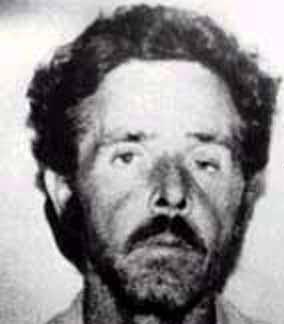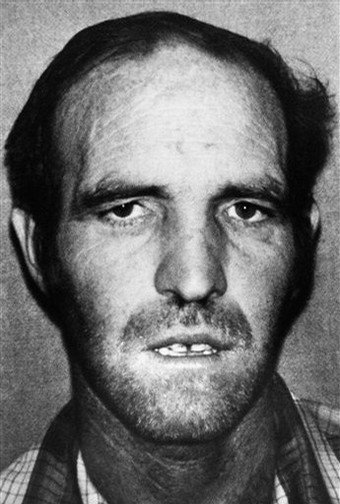
Photo courtesy of Jacksonville Police Department
If you have already read our piece on Henry Lee Lucas, then you know about the partnership. Two drifters. Two broken childhoods. One of the most disturbing criminal duos in American history.
But while Henry Lee Lucas became the more recognizable name, Ottis Toole had his own trail of murder that existed long before the two of them ever crossed paths. And unlike Lucas, whose confessions became so wildly exaggerated that law enforcement eventually stopped believing most of them, many investigators who worked these cases up close maintained that Ottis Toole was the real deal. A genuine serial killer. And something worse.
He was convicted of six murders. He confessed to many more. And he died in a prison cell in 1996 still connected to one of the most heartbreaking child murder cases this country has ever seen.
A Childhood Built for Darkness
Ottis Elwood Toole was born on March 5, 1947, in Jacksonville, Florida. What passed for a childhood in that household was something most people could not imagine.
His father abandoned the family when Ottis was young. His mother was described as a religious extremist who dressed her son in women’s clothing. His older sister sexually abused him. His grandmother was reportedly a Satanist who involved the young boy in occult practices and took him along to rob graves for body parts she used in rituals.
Before he was a teenager, Ottis Toole had been exposed to sexual abuse, religious fanaticism, and the occult all under the same roof. He dropped out of school in the ninth grade. He had an IQ of 75. He later told reporters that he knew he was gay by age ten and began frequenting gay bars as a young teenager.
At fourteen years old, a local traveling salesman propositioned him for sex. Toole’s response was to run the man over with his own car and kill him. That was 1961. It would be the first of many.
More True Crime: Curious Encounters: Delving into the Dark World of Henry Lee Lucas
From there, Toole drifted. He moved around the country for years, picking up arrests for loitering and other minor offenses, suspected in murders in Nebraska and Colorado that he was never charged with. He supported himself through panhandling and prostitution. He had no stable home, no job, and no anchor. He was also a pyromaniac who later admitted that setting fires gave him sexual gratification.
Meeting Henry Lee Lucas
In 1976, Ottis Toole was at a Jacksonville soup kitchen when he met a drifter named Henry Lee Lucas. Lucas had already served ten years in prison for killing his own mother. The two men found in each other a twisted kinship rooted in shared histories of abuse, violence, and a complete disregard for human life.
They became partners in every sense. They traveled together, committed crimes together, and by their own accounts, killed together. Lucas and Toole later claimed to have murdered more than a hundred people across multiple states over several years. Investigators would eventually determine that many of those confessions were exaggerated or outright false, particularly in Lucas’s case, where it was shown mathematically impossible for him to have been in the locations he claimed on the dates in question.
The skepticism around Lucas, however, did not fully extend to Toole. Several investigators who worked these cases closely believed Toole’s claims were more grounded in reality. Unlike Lucas, who seemed to revel in the celebrity of his confessions, Toole came across to many as someone describing things he had actually done.
The Murders He Was Convicted Of
Toole’s confirmed kills were concentrated in Florida between 1980 and 1983. The victims were people whose paths crossed his in the worst possible way.
John McDaniel, Jerilyn Peoples, Brenda Burton, and Ruby McCary were all killed during burglaries. Jerilyn Peoples, 18, and Brenda Burton, 23, were both stabbed to death inside their homes after they interrupted Toole and Lucas mid-burglary. Ruby McCary, 71, was shot dead in her home.
In 1982, Toole set fire to the home of 64-year-old George Sonnenberg in Jacksonville. Sonnenberg died from his injuries. Toole later claimed he had not intended to kill Sonnenberg and that he had only signed the confession to get extradited back to Jacksonville from another jurisdiction. The jury did not believe him. On April 28, 1984, he was convicted of first degree murder and sentenced to death.
Later that same year, Toole was convicted of the February 1983 murder of Ada Johnson, a 19-year-old woman from Tallahassee. He had kidnapped her at gunpoint from a nightclub and shot her in the head. Her body was found in the woods. He received a second death sentence.
Both death sentences were later commuted to life in prison on appeal. In 1991, Toole pleaded guilty to four additional murders and received four more life sentences. He would never be a free man again.
Adam Walsh
On July 27, 1981, six-year-old Adam Walsh went to a Sears store at a mall in Hollywood, Florida with his mother, Reve. She let him stand a few aisles away in the toy department while she looked at lamps. When she came back, he was gone.
Two weeks later, Adam’s severed head was found by a fisherman in a drainage canal near Vero Beach, more than 100 miles away. His body was never recovered.
The nation was devastated. Adam’s father, John Walsh, channeled that grief into action. He became one of the most prominent victims’ rights advocates in American history and went on to create and host America’s Most Wanted. The Walsh family’s efforts helped launch the National Center for Missing and Exploited Children, put children’s faces on milk cartons, and directly changed how law enforcement handled missing children cases across the country.
Meanwhile, the investigation into who killed Adam Walsh was a slow-moving disaster.
In October 1983, while already in prison on other charges, Ottis Toole confessed to killing Adam. He told investigators he had lured the boy into his car with promises of toys and candy. When Adam became upset and would not stop crying, Toole beat him, strangled him with a seat belt, and then decapitated him with a machete along a rural stretch of road. He said he drove around with the remains for days before dumping the head in the canal.
It was a confession that matched autopsy findings in disturbing detail. And then the Hollywood Police Department lost the evidence.
The bloodstained carpet from Toole’s impounded car disappeared. The machete could no longer be tested. Eventually, the car itself was lost. Toole recanted the confession. Without physical evidence, prosecutors could not charge him. The case sat open for over two decades.
Toole confessed and recanted so many times in so many cases that investigators struggled to know which statements to trust. But in the Walsh case, those closest to it never moved off Toole as their suspect. John Walsh himself said for years that he knew Toole had killed his son.
Before Toole died, his niece said he made a deathbed confession, telling her he had killed Adam Walsh.
On December 16, 2008, twenty-seven years after Adam disappeared from that mall, Hollywood Police Chief Chadwick Wagner stood before cameras and announced the case was closed. Toole had killed Adam Walsh. The department apologized to the Walsh family for the mistakes made during the investigation. Wagner acknowledged the evidence had been mishandled, that the case could have been closed years earlier, and that it should have been.
There was no new DNA evidence. There was no dramatic breakthrough. There was only the weight of everything that had always been in front of them. John Walsh wept at the podium. “The not knowing has been a torture,” he said. “But that journey is over.”
It is disgusting that it took 27 years and that a family had to suffer that long waiting for answers that should have come far sooner. The mishandling of that evidence is a failure that cannot be undone.
The End
Ottis Toole died on September 15, 1996, at Florida State Prison. The cause was cirrhosis of the liver. He was 49 years old. When he died, no family member came to claim his body. He was buried in the prison cemetery.
He was convicted of six murders. He confessed to more than a hundred. How many of those confessions reflected reality will likely never be fully known.
What is known is this: six families in Florida lost someone to Ottis Toole between 1980 and 1983. A six-year-old boy named Adam Walsh was taken from a mall, murdered, and decapitated by a drifter who had been killing since he was a teenager. And a department’s careless handling of evidence meant that a grieving father had to wait nearly three decades to hear his son’s killer named out loud.
Adam Walsh was six years old. He deserved better. His family deserved better. And the failures that allowed Toole to drift through life for years before anyone stopped him deserve to be remembered alongside his crimes.
More True Crime: The Wishing Well: Betty Lou Beets
Lisa Crow contributed to this article. She is a true crime junkie and lifestyle blogger based in Waco, Texas. Lisa is the Head of Content at Gigi’s Ramblings and Southern Bred True Crime Junkie. She spends her free time traveling when she can and making memories with her large family which consists of six children and sixteen grandchildren.